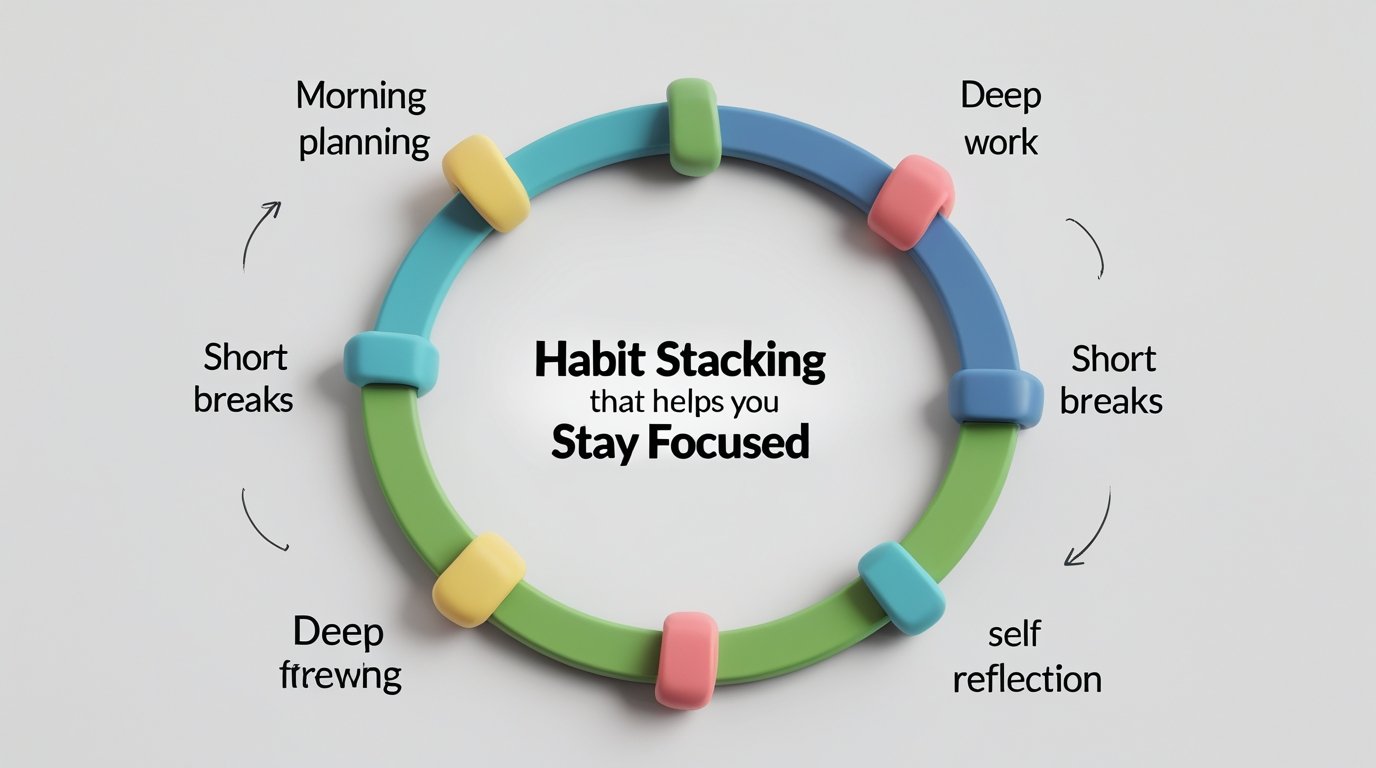
I have experienced many things in my life, and if I were to share them all, this article would become 10,000 words long. After that, I took a look at my habit stacking; my habits were increasing excessively, and it was having a very negative impact on my life. I was unable to stay focused on my work, life, and many other things. Therefore, the purpose of writing this article is to share with all of you how you can solve this problem and improve your habit stacking.
Chapter 1: The Anatomy of a Habit Stack:
Most people try to build habits out of thin air. They say, “I will start meditating at 8:00 AM.” But 8:00 AM is just a number on a clock. If you’re in the middle of a phone call or making toast, that habit has no “home.”
Habit Stacking (a term popularized by James Clear) uses a simple formula:
“After [Current Habit], I will [New Habit].”
The “Current Habit” is your Anchor. It’s something you do every single day without thinking, like brushing your teeth, pouring coffee, or closing your laptop. By “stacking” a focus-habit on top of an anchor, you use the existing neural pathways in your brain to pull the new behavior along for the ride.
Chapter 2: My “Deep Work” Morning Stack:
This is the stack that saved my career. Before I implemented this, my mornings were reactive. Now, they are proactive.
The Anchor: The First Sip of Coffee:
I never forget my coffee. It is my strongest anchor.
- The Stack: “After I take my first sip of coffee, I will open my physical planner and write down my ‘Big Three’ for the day.”
- Why it works for focus: It forces me to define “victory” before I open my laptop. If I open the laptop first, the internet defines my day for me. By writing my priorities while I enjoy that first hit of caffeine, I’m aligning the dopamine of the reward (coffee) with the act of planning.
The Extension: The “Laptop Lid” Ritual:
- The Stack: “After I open my laptop lid, I will close all browser tabs from yesterday and open only the one needed for my first task.”
- Personal Tip: This is the “digital room sweep.” It prevents the immediate overwhelm of seeing twenty unread messages or half-finished articles from the night before.
Chapter 3: Why Your Brain Loves Stacks:
Our brains are essentially energy-saving machines. Every time you have to make a decision, “Should I work now? Should I check my phone?”, you use a tiny bit of “decision fuel” (glucose in the prefrontal cortex).
1. Synaptic Pruning and Strengthening:
Your brain has “superhighways” for habits you’ve had for years. When you stack a new habit, you are essentially “hitchhiking” on a superhighway. The brain doesn’t have to build a new road from scratch; it just adds an exit ramp.
2. Reducing Decision Fatigue:
By the time 2:00 PM rolls around, most of us have made thousands of tiny choices. This is when our focus usually breaks, and we head for the “junk food” of the internet (social media). Habit stacking automates the transition between tasks, saving that precious “decision fuel” for the actual work that matters.
Chapter 4: Stacks to Beat the “Afternoon Slump”
We all know the feeling. It’s 3:00 PM, the lunch-high is gone, and your brain feels like it’s made of cotton. This is where I use Transition Stacks.
1. The “Lunch Plate” Reset:
- The Anchor: Putting my lunch plate in the dishwasher.
- The Stack: “After I put my plate in the dishwasher, I will set a timer for a 10-minute ‘power walk’ or stretching.”
- Focus Impact: Movement flushes the brain with oxygen. I found that if I just sat back down at my desk, I’d spend the next hour in a daze. The physical anchor of the dishwasher forces the transition into movement.
2. The “Phone Charge” Protocol:
- The Anchor: Plugging my phone in for its afternoon charge.
- The Stack: “After I plug my phone in, I will leave it in another room and set a ‘Deep Work’ timer for 60 minutes.”
- The Benefit: I use the physical act of charging as a signal that the phone is “dead” to me for the next hour. It creates a physical boundary within which my focus can thrive.
Chapter 5: The “Shutdown” Stack:
Focus isn’t just about what you do in the moment; it’s about how you leave your workspace the night before. I call this “Closing the Loop.”
1. The “End of Day” Anchor:
- The Anchor: Turning off my desk lamp (or closing my work email).
- The Stack: “After I turn off my desk lamp, I will clear all physical clutter from my desk and write down the ‘First Step’ for tomorrow morning.”
- Why the ‘First Step’ matters: Most of us procrastinate because the first task feels too big. If I write “Write Article,” I’ll avoid it. If I write “Open Word doc and type the title,” it’s easy. I stack this “mental prep” onto the act of leaving the desk.
Chapter 6: How to Build Your Own Stacks:
If you want to try this, don’t copy mine exactly, your life has different anchors. Here is the process I used to find what worked for me.
Step 1: The “Habit Audit”
Take a piece of paper and write down everything you do without fail every day.
- Waking up
- Making the bed
- Boiling the kettle
- Walking the dog
- Driving to work
- Checking the mailbox
Step 2: Identify your “Focus Gaps”
Where does your focus usually fail? Is it the first hour of the day? The hour after lunch? The “dead time” between meetings?
Step 3: Match the Frequency:
If you want to do a habit five times a day (like deep breathing), stack it on something you do five times a day (like drinking water). If it’s a once-a-day focus habit (like planning), stack it on your once-a-day morning coffee.
Step 4: The “Two-Minute Rule”
When you first stack a habit, make it too small to fail.
- Wrong: “After I sit down, I will work for 3 hours.”
- Right: “After I sit down, I will write for 2 minutes.” Once the connection is made in your brain, you can naturally increase the duration. The stack is about the start, not the finish.
Chapter 7: Why Stacks Fail:
In my first month, I failed a lot. Here is what I learned about the “dark side” of habit stacking.
- The “Weak Anchor”: I tried to stack a habit on “Checking my phone.” That’s a terrible anchor because I check my phone a hundred times a day at random intervals. An anchor must be consistent and specific.
- The “Overstack”: I once tried to stack five new things on my morning coffee. I ended up resenting the coffee. Start with one new habit per anchor. Once it feels automatic (usually after 2–3 weeks), then you can add a second “layer.”
- The “Environment Conflict”: If you want to stack “Reading a book” onto “Getting into bed,” but your book is in the living room, you will fail. The environment must support the stack. Put the trigger in the path of the anchor.
Conclusion:
Habit stacking changed my life because it took the pressure off my willpower. I stopped trying to “be a focused person” and started building a “focused environment.” By leveraging the things I was already doing, I turned my daily chores into triggers for my best work.
Start small. Find one anchor today, maybe it’s the moment you hang up your coat or the moment you finish your morning tea, and stack one tiny focus-habit on top of it. You’ll be amazed at how quickly those small “layers” turn into an unbreakable wall of productivity.
Frequently Asked Questions:
1. How long does it take for a “stack” to feel automatic?
Research suggests anywhere from 18 to 66 days, but with habit stacking, I’ve found it’s often faster (around 3 weeks) because you aren’t creating a new cue; you’re just borrowing an old one.
2. Can I stack habits in the middle of the workday?
Absolutely. One of my favorites is: “After a meeting ends, I will spend 2 minutes summarizing the next steps before I check my email.” This prevents “meeting amnesia” and keeps you focused.
3. What if I miss a day?
Never miss twice. Missing once is an accident; missing twice is the start of a new habit (a bad one). If you skip a stack, just get back on the rails immediately the next time the anchor occurs.
4. Can habit stacking help with “Digital Minimalism”?
Yes! “After I put my phone on the charger at night, I will put it in a drawer.” The physical act of charging becomes the cue to disconnect.
5. Does it matter if the new habit comes before or after the anchor?
Usually, after is better because the anchor acts as the “Starting Gun.” However, some people prefer “Before” (e.g., “Before I have my coffee, I must do 10 minutes of deep work”). This turns the anchor into a reward.
6. What is the best anchor for people who work from home?
The “Computer Startup.” It’s the universal signal that work has begun. Use those 30 seconds of booting up to breathe or set one intention, rather than immediately reaching for your phone.